
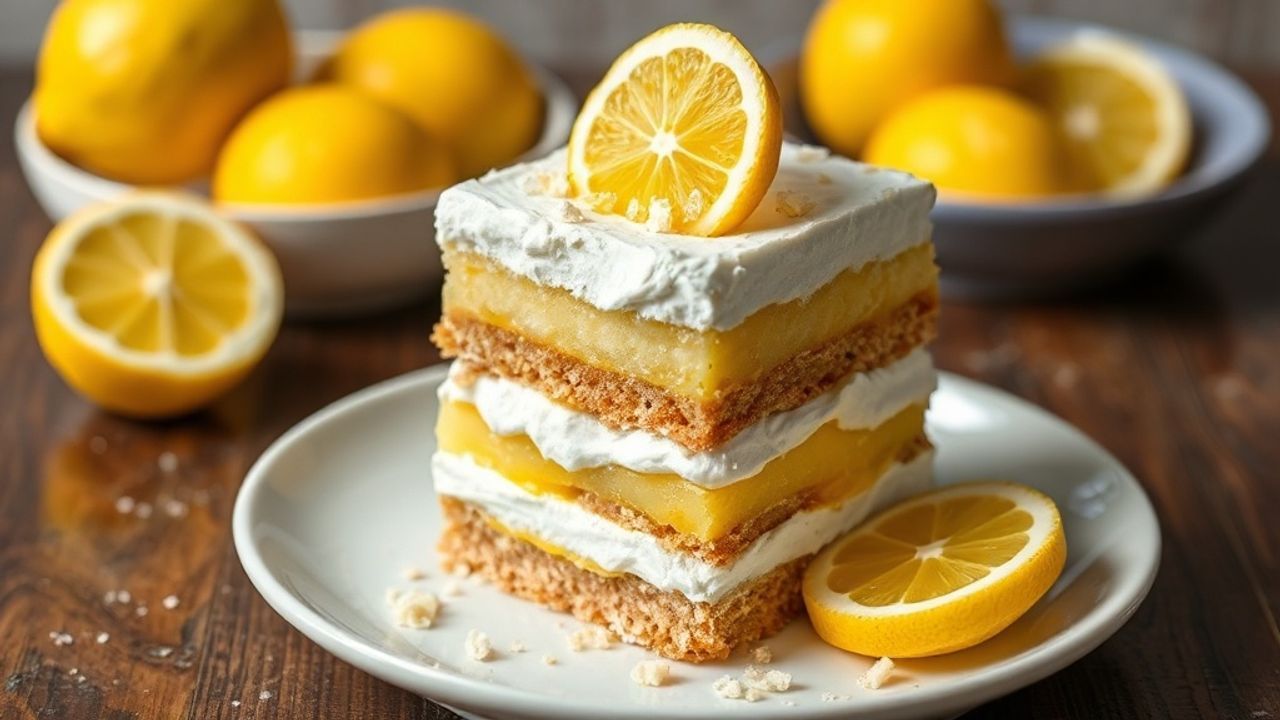
Lemon Lush delivers bright citrus, silky cream, and a crisp crust in a layered dessert that reads like a celebration on a plate. This guide explains why Lemon Lush works, how to make it reliable every time, and which small adjustments lift texture and flavor.
- Key takeaway: balance acid and sugar for a clean lemon punch.
- Make ahead: chilling improves sliceability and flavor melding.
- Texture tip: fold whipped cream gently to keep the topping airy.
- Storage: refrigerate tightly covered; consume within three days for best quality.
Overview: What is Lemon Lush?
Lemon Lush is a layered bar built from a compact crumb crust, a cooked lemon curd or custard-like center, and a light cream-cheese or whipped topping. The contrast of textures and the bright citrus flavor set it apart from single-layer lemon bars or simple tarts.
The filling behaves like a cooked curd or stabilized custard and requires correct cooking and cooling to set. For technical background on curds and citrus chemistry, review the lemon and custard entries.
Prep and Cook Time
Readiness: active work runs about 20 minutes. Chilling time drives structure, so plan at least four hours for a firm slice; overnight is preferable.
If you make the curd a day ahead, cool it in a shallow pan to hasten safe chilling and to stabilize texture. For events, assemble the day before to reduce service stress and improve layer definition.
Yield and Difficulty
Yield: a 9×13-inch pan yields roughly eight generous slices when cut into neat rectangles. The recipe scales predictably if you halve or double quantities.
Difficulty: easy-to-medium. Techniques are basic, but timing and temperature control matter. Cooks with routine stovetop skills will succeed when they follow timing cues and simple tests, such as the spoon-coating test for curd.
Ingredients
The classic Lemon Lush uses a graham-cracker or cookie crust, a cooked lemon curd center, and a whipped cream-cheese finish. Use fresh citrus and room-temperature dairy for best results.
Core items include graham cracker crumbs, granulated and powdered sugar, unsalted butter, cream cheese, heavy cream, egg yolks, and fresh lemon juice with zest. For context on graham crackers and yolk function, see graham cracker and egg yolk.
- 1 ½ cups graham cracker crumbs
- ⅓ cup granulated sugar
- 6 tbsp unsalted butter, melted
- 1 cup powdered sugar, sifted
- 8 oz cream cheese, softened
- 2 cups heavy whipping cream
- 4 large egg yolks
- 1 cup granulated sugar
- 1 cup fresh lemon juice (about 4-5 lemons)
- 1 tbsp lemon zest, finely grated
- 2 tbsp all-purpose flour
- ½ tsp salt
Instructions
Work in stages so textures develop correctly. Start with the crust, then prepare the cooked curd, and finish with a stabilized whipped topping folded into cream cheese for lift.
Always assemble with cooled curd and fully chilled whipped cream; warm curd will deflate the topping and blur the layers. Below are practical steps with technique notes for reliable outcomes.
1. Prepare the crust
Combine graham crumbs, granulated sugar, and melted butter until evenly moistened. Press the mix firmly into the bottom of a 9×13-inch baking dish to form a compact base.
Chill the crust in the refrigerator while you make the curd. A well-chilled crust prevents seepage and preserves clean layer separation when you pour the filling.
2. Cook the lemon curd filling
Whisk the egg yolks, sugar, lemon juice, zest, flour, and salt until smooth. Cook over medium-low heat, stirring constantly, until the mixture thickens and coats the back of a spoon — about 8–10 minutes; avoid rapid boiling.
Remove from heat and cool slightly before pouring over the chilled crust. If you spot any coagulated bits, strain the curd through a fine sieve to ensure velvet texture.
3. Assemble the cream layer
Beat softened cream cheese with powdered sugar until smooth. Separately whip the heavy cream to stiff peaks, then fold the whipped cream gently into the cream cheese to retain air and volume.
Use a rubber spatula and lift-and-fold motion. Dollop the mixture over the cooled curd, then smooth with an offset spatula for even thickness and an attractive finish.
4. Chill and serve
Cover the assembled pan tightly and refrigerate at least four hours; overnight produces the cleanest slices. Use a hot knife wiped between cuts for tidy portions.
Garnish sparingly to keep focus on layers. Thin lemon wheels, a light dusting of powdered sugar, or a tiny mint sprig finish each slice with restraint and elegance.
Tips for Success
Ingredient temperature control and measured mixing make the biggest difference. Room-temperature cream cheese blends smoothly; chilled heavy cream whips quicker to stable peaks.
Cook curd gently and test by running your finger through the mixture on a spoon; it should hold a clean line. If you need thicker set, add no more than 1/2 teaspoon extra flour to avoid pasty texture.
For texture, consider resting the curd in the fridge until it reaches about room temperature before assembly. This avoids shocking the whipped topping and helps preserve air in the cream layer.
Pro-Caution
Overcooking the curd causes graininess because proteins coagulate tightly when exposed to high heat. Cook just until the curd coats the back of a spoon and remove from heat promptly.
Avoid bottled lemon juice for best aromatic impact; fresh juice and zest deliver volatile oils and brightness. If you must use bottled juice, increase zest slightly to restore aroma.
Serving Suggestions
Serve chilled in rectangles so the layers remain visible. A neutral tea or a crisp sparkling wine refreshes the palate between bites and highlights citrus clarity.
Garnish sparingly to keep the visual focus on layers: a sifted dusting of powdered sugar, a thin lemon wheel, or a tiny mint sprig works well. For seasonal contrast, add fresh berries at service.
For related recipes and plating ideas, link this dessert visually to simple treats like lemon bars or pair it with other citrus desserts in a buffet. Use an internal guide on technique at curd technique for variations and troubleshooting.
Nutrition & Storage
Per-serving estimates vary by portion size and exact ingredients. A typical slice of Lemon Lush contains moderate calories from dairy and carbohydrates from sugar and crust.
Store covered in the refrigerator for up to three days to preserve texture. Freezing is not recommended because the cream layer can separate and become watery on thawing.
| Nutrient | Per Serving |
|---|---|
| Calories | 320 kcal |
| Protein | 4 g |
| Carbohydrates | 35 g |
| Fat | 18 g |
Why ingredients matter
Fresh lemon juice and zest deliver aromatics that bottled juice lacks; the flavor difference is tangible and measurable when you prioritize volatile oils from zest. Use ripe, firm lemons and zest before juicing to capture oils.
Egg yolks provide emulsification and thickening; they enable a smooth, stable curd when heated gently. If you want deeper technical context on yolks and dairy structure, see egg yolk and cream cheese.
Additional resources
For foundational detail about graham-based crusts and cracker history, consult the graham cracker reference. Understanding ingredient roles improves reproducibility and helps you adjust for altitude or humidity.
For further technical reading on citrus and curds, review the lemon and custard resources. These entries clarify acid behavior, pectin interactions, and protein coagulation relevant to curd making.
FAQ
How long should I chill a Lemon Lush before serving?
Chill at least four hours to allow the curd and cream layers to set. Overnight chilling yields the best slice definition and flavor melding.
Can I make Lemon Lush gluten-free?
Yes. Replace graham crumbs with gluten-free cookie crumbs or ground nuts and adjust the binder as needed. Almond flour or crushed gluten-free biscuits work well as a base.
Can I swap cream cheese for mascarpone?
Mascarpone gives a richer, softer topping and works if you prefer a creamier finish. If you use mascarpone, stabilize with a small amount of powdered sugar or a light gelatin bloom for firmer slices.
Is Lemon Lush suitable for advance preparation?
Absolutely. Making it a day ahead improves texture and reduces service stress. Keep refrigerated and cover tightly to prevent flavor transfer and surface drying.
What causes a curd to become grainy and how do I fix it?
Overcooking or too-high heat makes curd proteins coagulate and feel grainy. To repair, strain the curd through a fine mesh sieve and whisk in a small amount of warm butter while off the heat to smooth it, then cool gently.
With clear technique and the right ingredients, a Lemon Lush will present clean layers, lively lemon flavor, and an elegant finish. Apply these steps and expert notes to make each batch consistent and crowd-pleasing.
See also: Lemon Lush